

Your Website Ranks on Google. So Why Doesn’t ChatGPT Know You Exist?
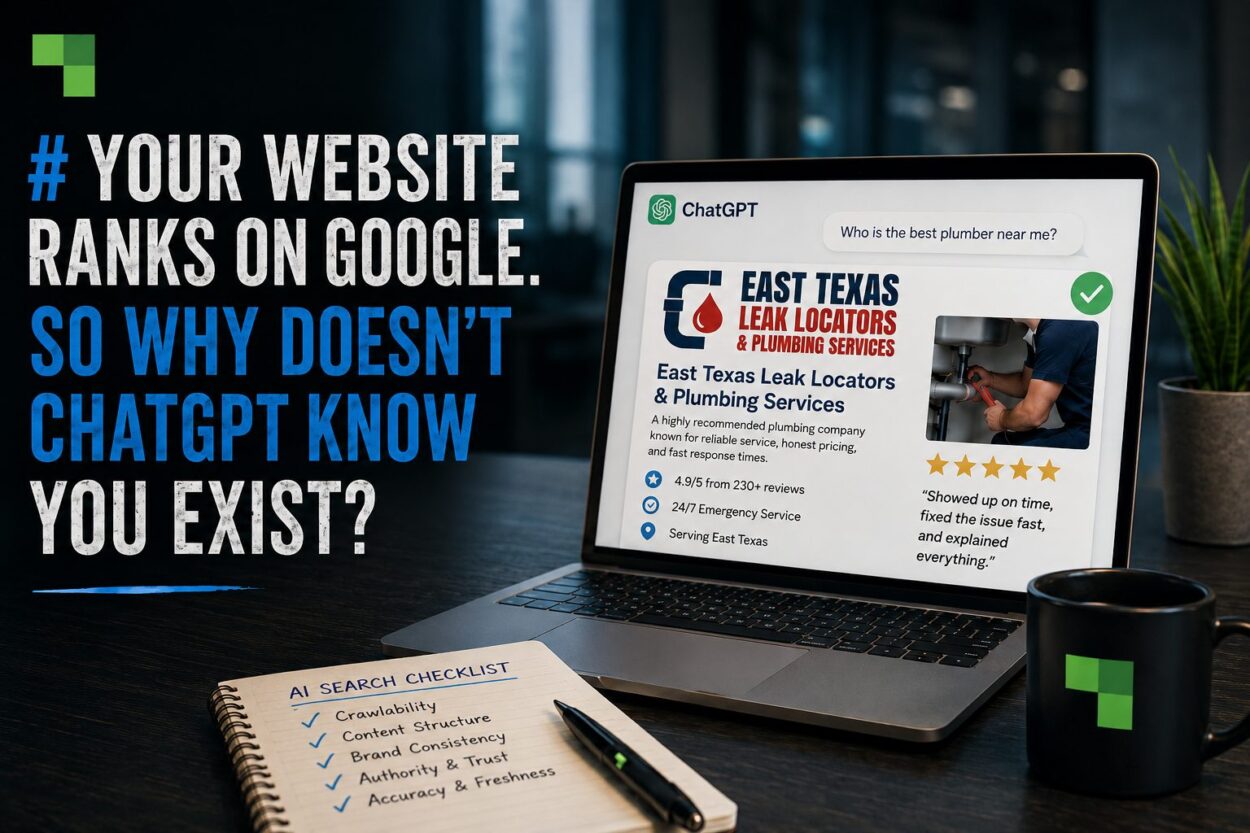
Quick story. One of our plumbing clients was doing work for a new customer last week and, out of habit, asked how they’d found him. Not Google, not a friend’s referral. ChatGPT. The customer had asked for a recommendation, and it didn’t just spit out a name. It explained why it was recommending him, pulled in his reviews, and laid out details about the exact service the customer needed.
That’s the kind of moment that makes you sit up. It’s also exactly what we’re working on for our customers at Local Leap, because it doesn’t happen by accident. It happens because the groundwork was already in place before that customer ever typed a question into ChatGPT.
That groundwork is AEO, GEO, AI SEO, or whatever acronym you want to throw at it. The short version is: people are asking ChatGPT, Gemini, Claude, and Perplexity for recommendations instead of Googling them. Best plumber nearby. Which bakery has the good stuff. Who to call for landscaping. Those questions are getting answered right now, pulled from somewhere on the web, and there’s no guarantee that “somewhere” includes you just because Google likes you.
This is the thing we spend most of our time on at Local Leap, so let’s get into why it happens and what actually helps.
First, the crawler has to reach you at all
Before an AI platform can say a single nice thing about your business, it has to get to your content in the first place. And a surprising number of decent websites are, without anyone intending it, closed off.
A few usual suspects:
- Robots.txt rules, firewalls, or CDN settings that quietly block AI crawlers. Most business owners have no idea this setting even exists, let alone that it’s flipped the wrong way.
- Content that’s mostly JavaScript, so a crawler shows up, finds an almost-blank page, and leaves before anything loads.
- A site that’s just slow. If a page times out or loads inconsistently, some crawlers won’t stick around to try again.
None of this is a content problem. Your writing could be the best in your industry and it wouldn’t matter, because the AI never actually got to read it.
Then it has to figure out who you are and whether to believe you
Say the crawler does get in. Now it’s trying to answer a harder question: is this business real, consistent, and worth citing?
A few things tend to trip this up, and honestly most of them are things any business owner would nod along to if you pointed them out:
Your business name or description doesn’t quite match across your site, directories, and profiles. Small inconsistencies, but they make it harder for an AI system to confirm you’re one legitimate entity and not three different half-finished listings.
There’s no clear sign of who’s actually behind the content. No byline, no credentials, nothing that reads as “a real person who knows this stuff wrote this.” Generic, could’ve-been-written-by-anyone content just doesn’t earn trust, from AI systems or from actual humans.
The good information is in there, but it’s buried. Long paragraphs, vague headings, no clear structure. An AI trying to extract a clean answer will often just skip the page and find one that’s easier to lift from.
Something on the page is stale. Old stats, a broken link, an example from three years ago. Small stuff, but it signals “maybe don’t trust this one.”
Any one of these is minor. Stack a few together and you’ve got a business that Google likes fine but AI platforms just quietly pass over.
What we actually do about it
This is the part where I’d love to tell you it’s one quick fix, but it’s not, it’s a handful of fixable things. At Local Leap, we go through a site the way an AI platform effectively does:
Can a crawler get in and read this without a fight? Is the business identity consistent everywhere it shows up? Is there real authority here, or does it read like filler? Can someone (or something) skim this and pull out a clean answer? Is everything still accurate?
We turn what we find into an actual plan, not a PDF full of jargon you’re supposed to figure out on your own.
Want to know where you actually stand?
The honest answer is most business owners have no idea whether they’re visible in AI search, because there’s no obvious way to check. That’s what our GEO audit is for. We look at crawlability, content structure, brand consistency, authority signals, and whether you’re actually getting cited, plus how you stack up against the competitors down the street who might already be pulling ahead of you in ways you can’t see yet.
Search is shifting faster than most people are watching. The businesses paying attention now are the ones getting the ChatGPT recommendation, the detailed reasoning, the reviews pulled in automatically, the whole pitch made for them before a customer even calls. Everyone else is still hoping Google’s enough.
Curious where your business stands? Reach out to Local Leap and let’s find out what’s actually holding your visibility back.